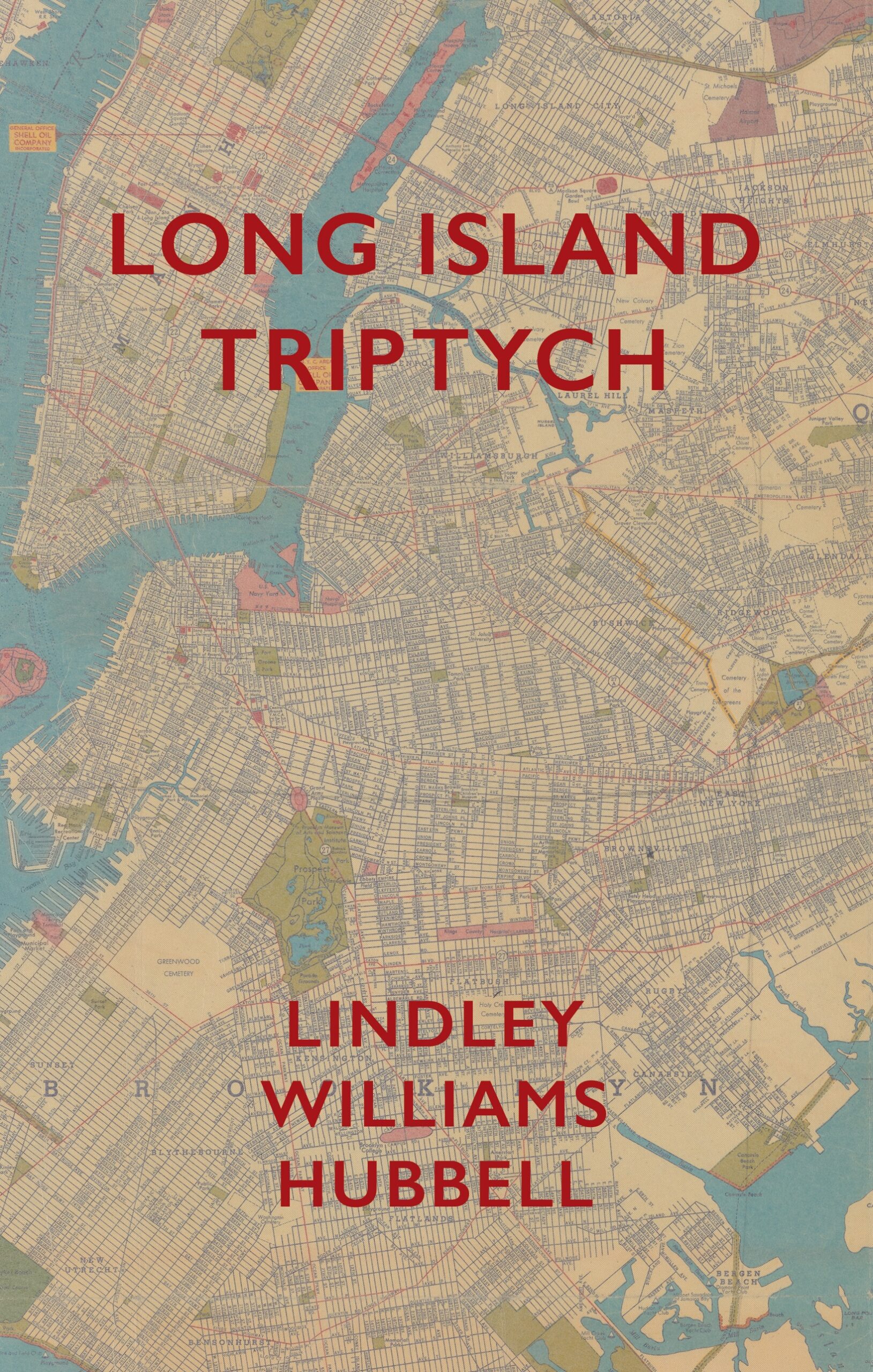
 Lindley Williams Hubbell (1901–1994) received a Yale Younger Poets Award in 1927, and his work afterwards appeared from several major U.S. publishers. Then in 1953 he moved to Japan and liked it so much that he never again left the country, taking Japanese citizenship in 1960. Thereafter he published almost exclusively in Japan, and his work became lost to view in his own country.
His most significant book, the last to appear in the U.S. before his departure, was Long Island Triptych and Other Poems (1947). In this book – and especially in its title poem separately reissued here – he broke through from his early style of short, finely cadenced lyrical poems to an ambitious and original modernism. In an afterword, editor Paul Rossiter argues that this modernism was inspired by the work of his friend Gertrude Stein, and especially by her writings on Cézanne, Picasso and the cubists.
The three panels of the Long Island Triptych focus on three Long Island neighborhoods – Greenpoint, Ridgewood, and Glendale – and each includes a great variety of material contained within a formal structure as rigorous as that of an analytic cubist work by Braque or Picasso. In a late essay comparing Gertrude Stein’s work with that of the cubists, Hubbell states: ‘as the Cubist painter took an object apart and then reassembled the parts according to a completely autonomous sense of design, so she disintegrated her ideational content and reorganized it into a purely formal design’. This taking apart and reassembling of multiple viewpoints is what Hubbell does with his three neighborhoods. The result is a festival of particulars held in a multi-faceted unity by the overarching poetic form.
Billy Mills has written a long and detailed review of the two Hubbell volumes: ‘Once again, I am indebted to Isobar, and Paul Rossiter, for broadening my knowledge of poetry, never having read Hubbell before. I share his hope that these books will bring him to a wider readership. Hubbell may not rank as a ‘major’ poet, but very few do. However, his body of work as represented here is significant, and forms an interesting extension to the story of American modernist poetry, particularly its relationship with Japan, which he extends beyond the boundaries of what might roughly be termed the Beat tradition. And in Long Island Triptych he wrote one of the more interesting mid-length poems of the mid-century period. Read him.’ Click here to read the whole review.
May 2025. 96 pages. 8.5 x 5.5in/216 x 140 mm. ISBN 978-4-907359-51-5 (paperback).